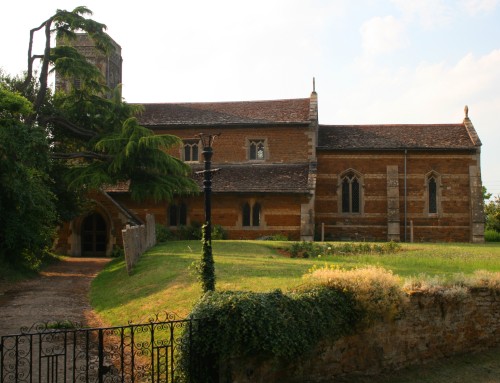
St. Mary - Ridlington
Village
The village of Ridlington sits two miles north-west from Uppingham and is a pretty village of stone cottages and narrow lanes.
In 1086 it is recorded in the Domesday Book as consisting of seven 'berewicks' or hamlets. These were probably Ayston, Belton-in-Rutland, Leighfield, Preston, Uppingham, Wardley and Wing.
"In Redlinctune Churchsoke with its seven
Berewicks Queen Editha
had four carucutes
of land rateable to gelt; the land is sixteen
carucutes.
The King has there tour carucutes
in demesne, and one hundred and seventy
villeins
and twenty six bordars who have thirty
carucutes; also two sokemen with two carucutes.
There are two priests and three churches, and two
mill-sites and forty acres of meadow.
The wood, containing pasturage in places, is two
miles long and eight furlongs broad.
The annual
value in King Edward's time was £40. The whole manor
with the seven Berewicks
is three miles and seven
furlongs in length, and two miles and two furlongs
in breadth.
Albert the Clerk (who held also, under the
King, the churches of Oakham and Hambleton)
has one
bovate of the above mentioned land, and has a mill
there worth 16d yearly."
Church
The church of St Mary Magdalene & St Andrew at Ridlington is an impressive building for such a quiet village; it consists of west tower, nave, north & south aisles, and chancel.
Most of the building dates from the 13th century; the tower in its present form dates from abount a century later.
Extensive restoration in 1860 left little older work remaining save the chancel arch, nave arcades, clearstory and tower, thus the history is difficult to follow. The 1860 work by a Henry Parsons of London consisted of rebuilding the aisles and chancel and replacing all the fittings, including the erection of new roofs throughout. In 1887 a new porch was erected, and in 1903 the upper part of the tower was rebuilt.
The font is modern, replacing one which was described in 1860 as "so much mutilated as to be useless." The new one has a bowl of triangular shape, with curved sides, supported on marble shafts with moulded capitals and bases.
The plate consists of a cup and cover paten of 1571, a paten and flagon of 1709-10 given by Richard Watts and a fluted paten or small alms dish of 1637-8, originally having two handles, but one now missing.
There are four bells, a treble by Taylor of Loughborough added in 1911 to a former ring of three, which had been recast, also by Taylor's 1903.
There are also memorials to Edward Chesilden (d. 1688) and other members of the Chesilden family (1725-1815), and to eight men of the parish who fell in the War of 1914-19.
A case containing a bassoon, fiddle, two oboes and a flute, which were in use until 1860, was placed at the west end of the church in 1923. The royal arms of Queen Victoria are in the vestry.
Some items extracted from Wikipedia, the free encyclopaedia [link]