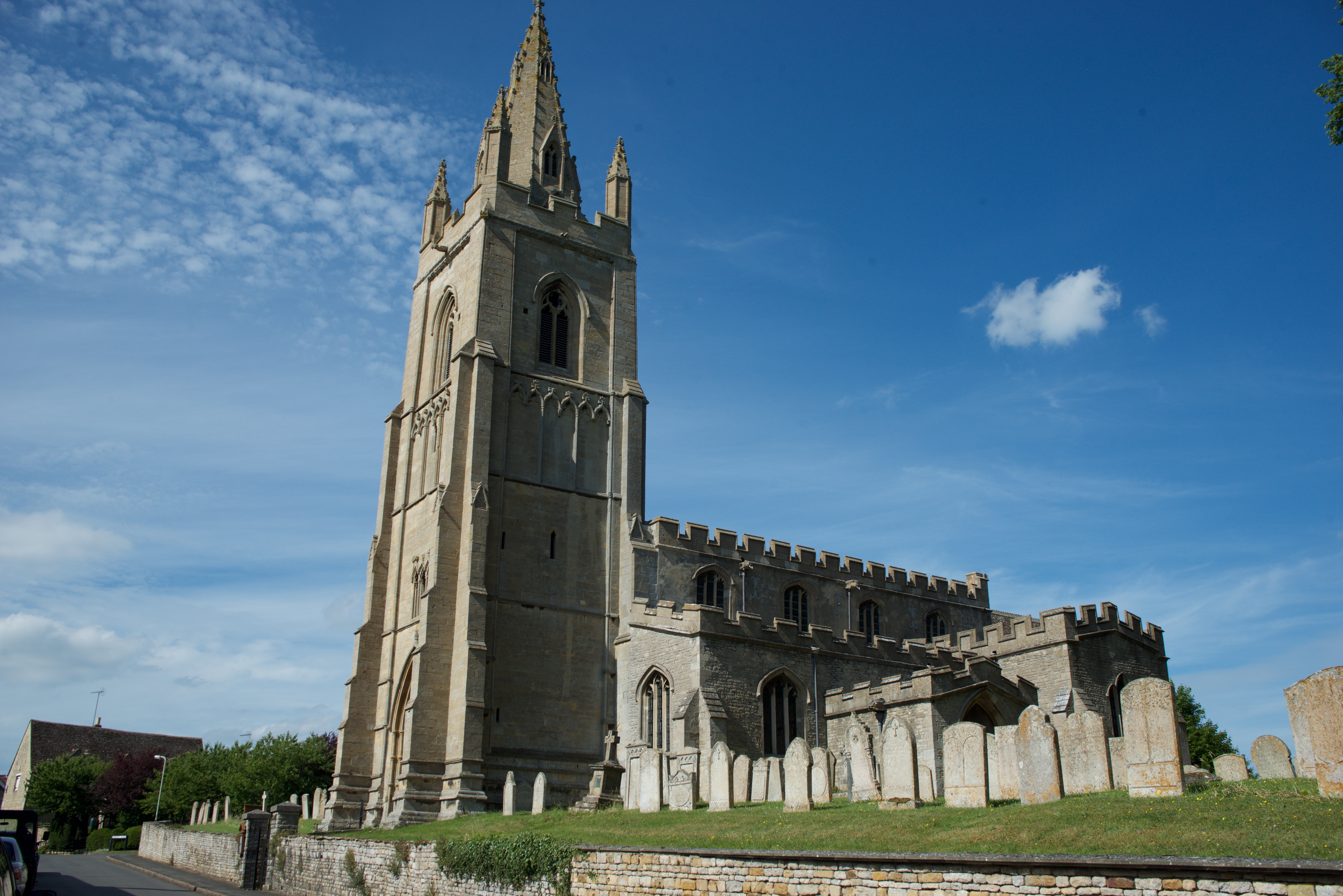
St Peter - Empingham
Churchyard
Recently digitised is the WI work on recording the headstones in the churchyard of St. Peters Church.
Village
Empingham lies close to the dam on the eastern end of Rutland Water. During its construction, Rutland Water was called "Empingham Reservoir", however it was renamed to preserve the name of Rutland county which was being merged with Leicestershire.
To the north east on the Great North Road (now the A1) the Battle of Empingham was fought in 1470 as part of the Wars of the Roses. The battle is also known as 'Battle of Losecoat Field' (or Losecote Field), supposedly because the defeated Lancastrians, when fleeing, threw off the distinguishing clothing. However the name probably predates the battle and means pigsty field. Forms of Losecote also appear as field names in other parishes in Rutland. Contemporary accounts refer to the battle site as Hornfield. An adjacent woodland is now called Bloody Oaks.
The name is Saxon and means the home of Epa's people.
The largest house in the village is Prebendal House. It belonged to a canon of Lincoln called the Prebendary of Empingham and was for his use when he visited. At the time of the Enclosure of 1795 the Prebendary exchanged it for some of the Heathcote lands. In 1843 the Prebendary ceased to have rights here, but there is still a titular Prebendary and a stall in Lincoln Cathedral bearing the name Empingham.
Church
The church of St Peter at Empingham dominates the village. Much of it dates from the 13th century. The tower and porch are 14th. There was a great restoration in 1894-5 and a new clock installed; the old one is in Stamford Museum and dates from 1686. It had neither hands nor face but struck the hour.
The church has developed from an aisle-less 12th century building; a south aisle was added around 1200 - 1210, the existing south arcade being of a similar period, and shortly after, about 1225, a north aisle was built. The transepts were added together with, or shortly after, the aisles. The rebuilding of the chancel on its present plan does not appear to have been finished until late in the 12th century.
In the 15th century the north transept was remodelled and its walls made higher; new windows were inserted in the aisles, the present clearstory was erected, the nave, aisles and transepts newly roofed, and the battlemented parapets added.
Medieval arrangements can still be seen, a triple sedile and a double piscine in the chancel, and the piscinae of two altars in each transept. There is also a piscina belonging to a former chapel at the west end of the south aisle. Traces of a rood-loft are to be seen, but no evidence of a staircase to the loft.
The font is in the style of the 14th century and dates from 1895. The late 17th-century hexagonal oak pulpit has plain panelled sides and fluted angle pilasters: it was re-fixed on a stone base at the restoration. The nave and aisles are seated with chairs.
There is a ring of six bells cast by Taylor and Co. of Loughborough in 1895.
In the Autumn of 2010, after a trial period, the Nave Altar was introduced by faculty. The altar table was made by Nicholas Meadwell of Meadwell Church Restorations, Uppingham.
Organ
More information on the organ can be found by following this link to the The National Pipe Organ Register (NPOR) entry.
Some items extracted from Wikipedia, the free encyclopaedia [link]