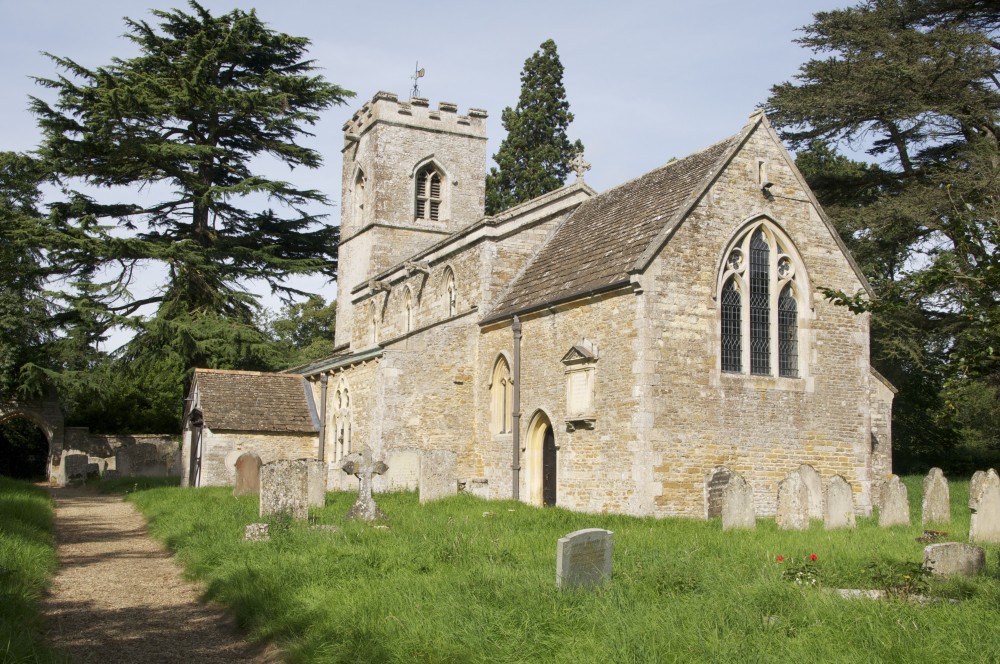
St Martin - Lyndon
Village
Lyndon is a village between North Luffenham, and Manton, not far from the South shores of Rutland Water. It is believed that the name is derived from Old English 'lind' (linden or lime tree) and 'dun' (hill).
Thomas Barker (1722-1809) of Lyndon Hall kept a detailed weather record from 1736 to 1798. William Whiston (1667-1752), best known for his translation of Josephus, died at the Hall, the home of his son-in-law, Samuel Barker on 22 August 1752.
Church
The church of St Martin at Lyndon is an attractive building surrounded by impressive trees. The scene is wonderfully set by the sign welcoming visitors to picnic in the grounds. It is mainly 13th and 14th century, the font possibly dating from the 12th century. It was found buried in the church grounds in 1865, when the Victorian restoration was in progress. For this reason it is thought that there may have been an earlier church at this site.
The tower is 14th century, with the top part being rebuilt later. The church has four bells with the earliest dated 1597. Another bell, dated 1624, by Tobie Norris of Stamford, is inscribed "Let all things be done for the Glory of God".
Martin of Tours (c. 316 - 397) patron saint of France and of soldiers. While Martin was still a soldier at Amiens he experienced the vision that became the most-repeated story about his life. He was at the gates of the city of Amiens with his soldiers when he met a scantily dressed beggar. He impulsively cut his own military cloak in half and shared it with the beggar. That night he dreamed of Jesus wearing the half-cloak Martin had given away. He heard Jesus say to the angels: "Here is Martin, the Roman soldier who is not baptised; he has clad me." (Sulpicius, ch 2). The dream confirmed Martin in his piety and he was baptised at the age of 18. He died at the age of 82, and was one of the first non-martyr saints.
Organ
More information on the organ can be found by following this link to the The National Pipe Organ Register (NPOR) entry.
Some items extracted from Wikipedia, the free encyclopaedia [link]